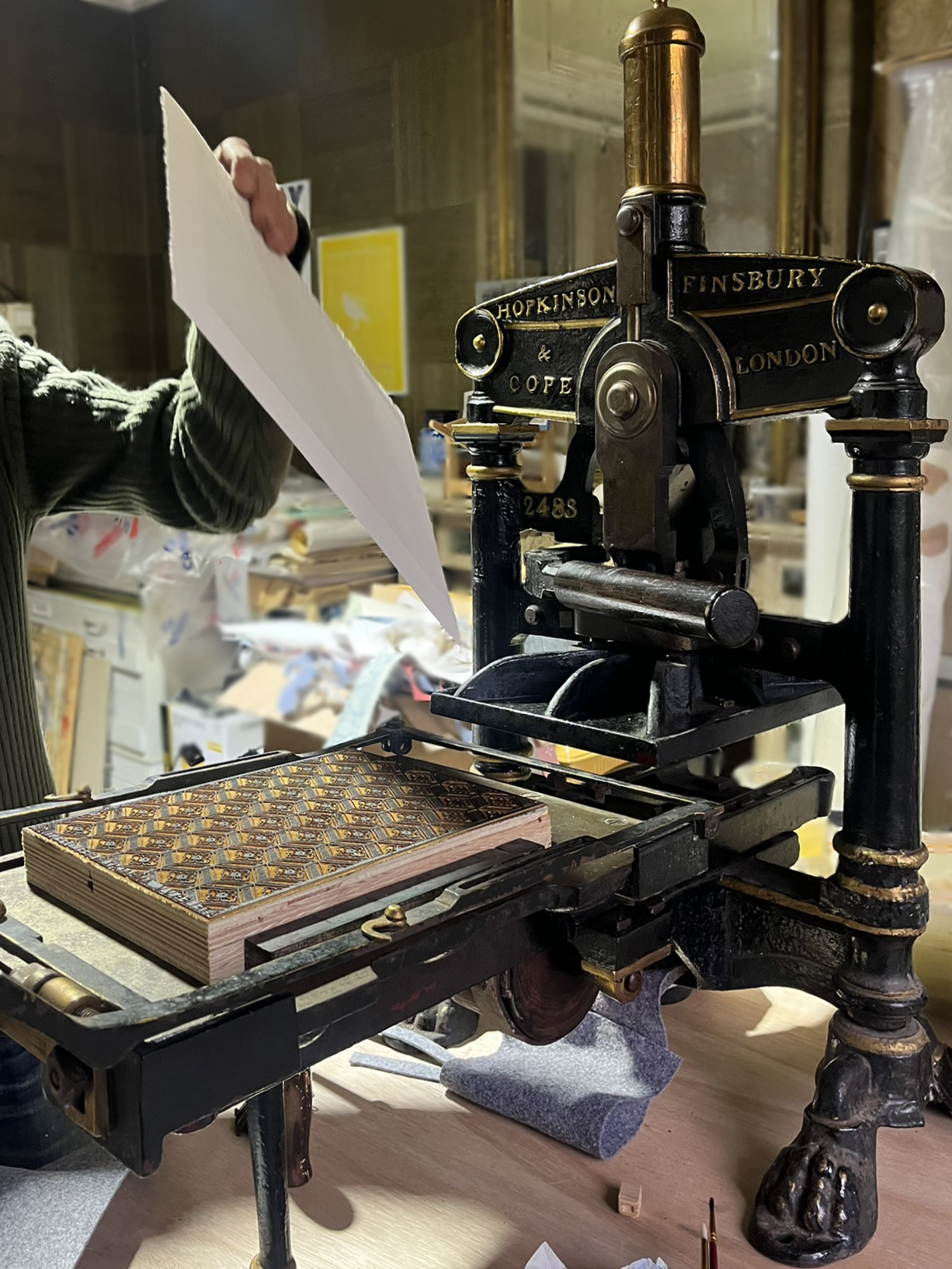
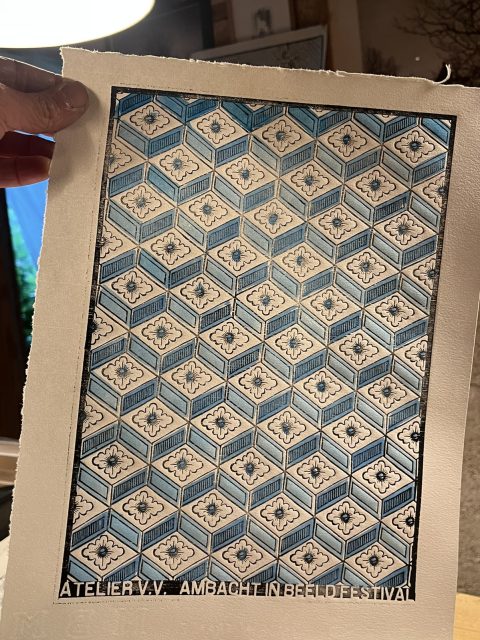
During this workshop, you will get hands-on with a classic platen press from the first half of the 19th century. You will print a domino, an early form of wallpaper, using a wooden block.
After printing, you will finish your print with color, applied using a stencil and brush. For this, you will use an ink prepared according to a historical recipe, based on gum arabic and pigment.
You will learn how printed matter was constructed in the past: applying ink, positioning the paper, setting the print, and finishing. No theory, just doing.
You will work with authentic materials: wooden printing blocks, traditional inks, and Arches paper.
Afterwards, you will take home a unique, handmade sheet.
Everything happens continuously: you can join in, participate, and move on. Short, tangible, and direct.
Atelier V.V. creates hand-printed wallpaper using a technique that had disappeared from Belgium for more than half a century: printing with the slab. Dimitri and Vicky print their patterns block by block, color by color, using large wooden printing blocks and paint they make themselves based on historical recipes.
Where industrial wallpaper is flat and uniform, here a surface emerges with nuance, depth, and small variations — visible and tangible.
In addition to rolls of wallpaper, Atelier V.V. also prints dominoes: early forms of printed paper that served as precursors to wallpaper. These are printed sheet by sheet, just as in the past.
The atelier works on both new interiors and restorations, always with respect for materials, techniques, and history.
Dimitri Vermeylen is the driving force behind Atelier V.V., which he founded together with his wife Vicky Vermeire. After a career of more than twenty years in the business world, he returned to a craft practice, with a strong focus on historical printing techniques.
He immersed himself in the subject through volunteer work at the Industrial Museum in Ghent, among other things, where he worked with typography and lithography. Today, he and Vicky combine that technical craftsmanship with their own research into historical dyeing and printing methods.
Atelier V.V. has grown into one of the few studios worldwide that prints wallpaper in this way again.
During workshops and demonstrations, Dimitri shares his knowledge in a direct manner: not academically, but by doing, with attention to materials and techniques.
Thanks to Erfgoedcel Vlaamse Ardennen (Variant), FILA Benelux for sponsoring the Arches paper, and thanks to Patrick Goossens.
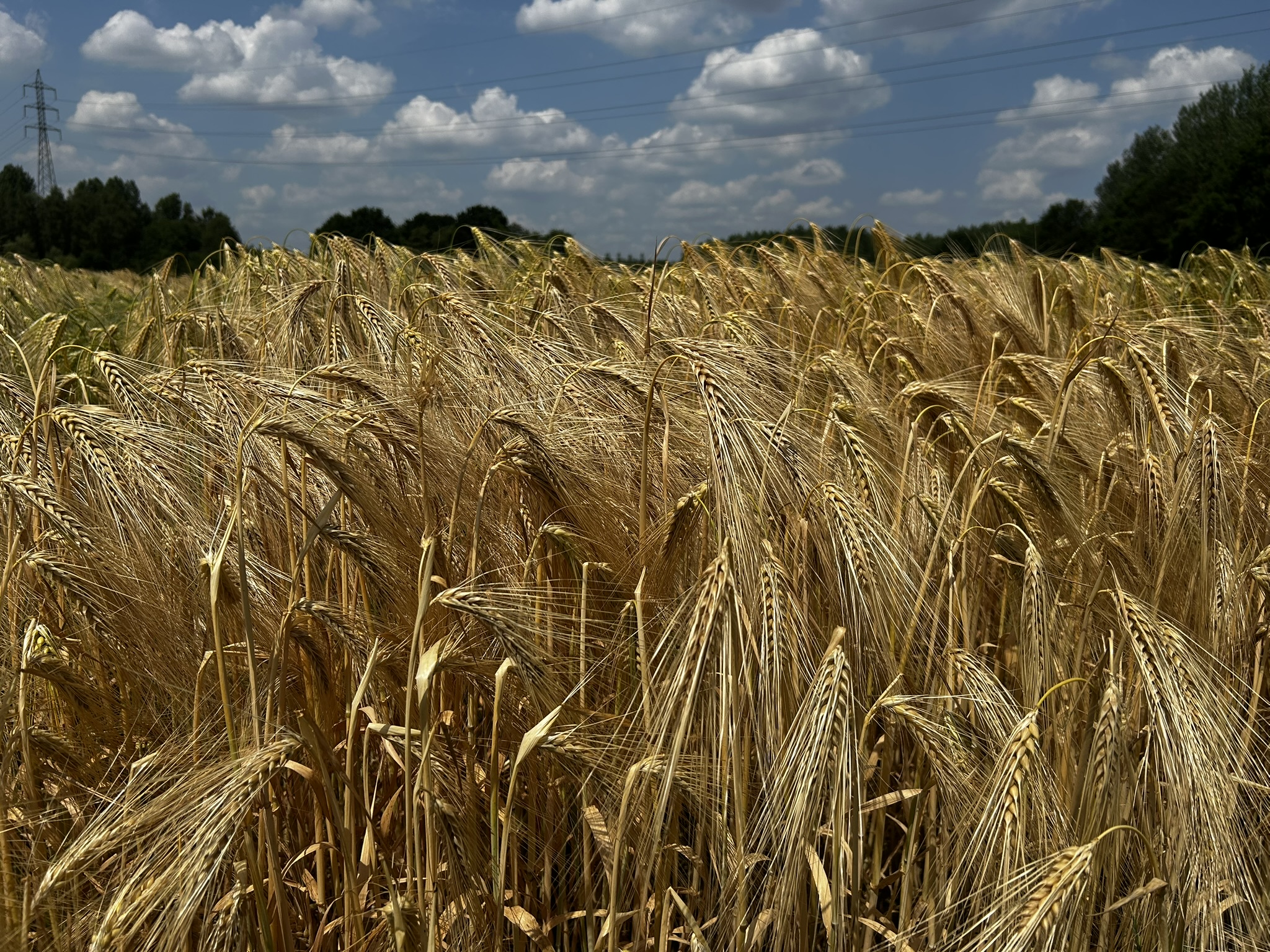
Mending flax rope with natural materials and a wire net.
We start with the twisting of fibers as a technique. You will make your own rope that has been coiled with care and attention using familiar and stable movements. With decorated strands, we get to work winding a lance and mastering the basic knots of mending. We work towards a structured pattern that systematically, rhythmically, and stably creates a wire net that can be used in everyday applications such as a shopping basket.
By the end, you will have made a net that you can take home and use.
Knisper Coaching: Guidance that is infectious. Working with your hands in an authentic, accessible way, through experience, and in a natural context. Getting started with bushcraft workshops to create various projects and tools from the forest. The guidance methodology starts with simple and honest materials from nature; with care and attention to the specific needs of the group or target audience, we choose tailored challenges. By combining coaching with productive manual work, participants achieve their results themselves. Here, we provide high-level support and, literally, guidance that is infectious.
Jelle Symons (Coach/Instructor – Leuven) is an enthusiastic coach and youth worker with a deep passion for craftsmanship, nature, and the outdoors. Drawing on years of experience in youth work, he combines craftsmanship with training, inclusion, and a strong appreciation for volunteering. Jelle believes that crafts are more than just techniques: they are connecting moments where people, young and old, discover their talents and learn from one another.
His background in outdoor education and bushcraft gives his workshops a warm, practical, and accessible approach. He creates spaces where experimentation is allowed, mistakes are made, and where everyone is welcome, regardless of experience or background. With great enthusiasm, he brings traditional manual labor back to life—from natural materials to ancient techniques—always with an eye for sustainability and collaboration.
At the festival, Jelle invites participants to slow down, connect, and rediscover what it means to create something with their own hands.
This workshop is offered by Erfgoedcel Mechelen and in collaboration with De Aanstekerij.

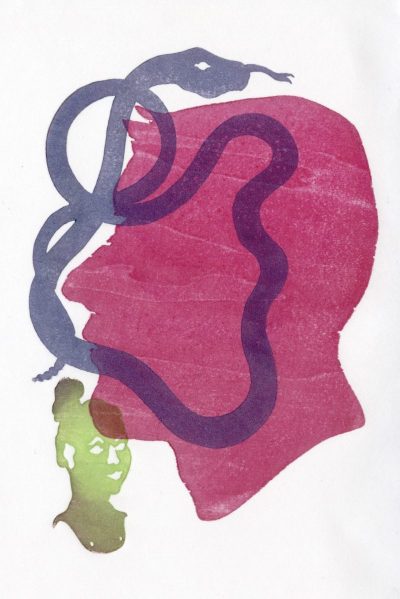
Are you particularly moved by the subtle and magical colors and color transitions when viewing a Japanese woodcut? Then this workshop is an absolute must. Here, you will discover the entirely unique printing method of this art form and get to work with it yourself. Using several pre-cut wood plates, you will create your own design. Together with your instructor, you will print your design and discover the wondrous and pictorial possibilities of printing with simple water-based paint.
You will go home with a mini-edition of 4 prints that you can enthusiastically show to friends and family.
With these workshops, we focus primarily on (absolute) beginners and amateurs who would like to experience the special character of the Japanese woodcut firsthand.
The Japanese woodcut, also known as mokuhanga, is the result of nearly 425 years of perfecting the woodcut technique, a technique that is also known in our region and has been practiced here since around 1400: the woodcut. This printing technique, and certainly its Japanese variant, stands out for its strong artisanal character, namely the extensive handiwork required to produce a satisfying woodcut. It is not enough to be able to create beautiful images; one must also think and feel within the possibilities and limitations of the material: the wood, the cutting tools, the paint, and the paper. A good Japanese woodcut is therefore the result of finding a perfect balance between thorough technical skills and free, creative, and artistic ideas. Japanese woodcut is one of the least toxic printing techniques in existence, possessing a very sustainable character and a low ecological impact, which directly explains its rising popularity worldwide.
Mokuhanga Magic is a creative project by Soetkin Everaert & Vladimir Ivaneanu. They pay homage to the centuries-old Japanese art of woodcutting – mokuhanga – a craft in which tradition, patience, and creativity come together. Each print is hand-carved and printed using natural materials and water-based pigments, resulting in unique and special works of art. Mokuhanga Magic is their way of sharing this beautiful, eco-friendly art form with the world. Soetkin and Vladimir offer original prints, workshops, and tools for both beginning and experienced artists. It is their mission to inspire, educate, and build a community around the magic of mokuhanga. Join them on this artistic journey, where every print tells a story.
Since 2019, Bokrijk | Craftsmanship & Heritage has been Bokrijk’s center of expertise focusing on the contemporary relevance of historical woodworking and construction techniques. From the Campus of Craftsmanship, V&E inventories, researches, supports, and communicates this craftsmanship heritage throughout Flanders and Brussels. As a service provider, V&E is part of a strong national network and also operates as an international knowledge actor. Jeroen Desaver and Rien Bogaert will be present to share information about this.

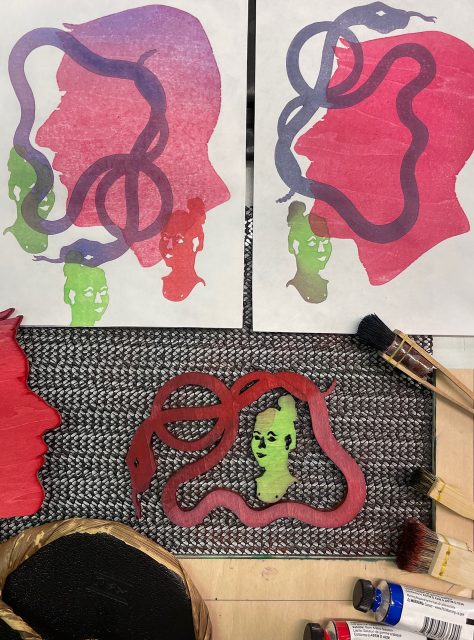
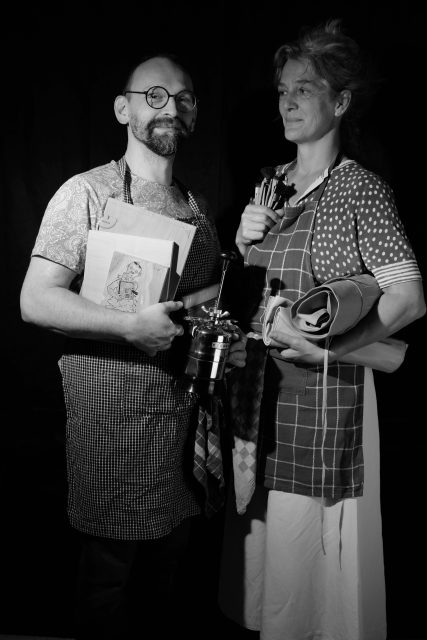

During the festival, children can make their own mosaics using all kinds of odds and ends. They can use any kind of material—those bits and pieces, toys, and trinkets that everyone has lying around.
Materials will be available for the children to choose from to form their own mosaic. The children can then decide for themselves whether to fill in a drawn silhouette or to sort out the colors to create a more realistic image.
The panels will eventually form one colorful whole.
Ismaël Bils studied installation art at KASK in Ghent and creates all kinds of artworks, primarily using recycled materials. Years ago, Ismaël started making mosaics from all kinds of waste materials. He began with simple silhouettes, filled with all kinds of colorful material. First on boards and on the wall of his room. But because he enjoyed it so much, he eventually decorated the entire garden wall of his house.
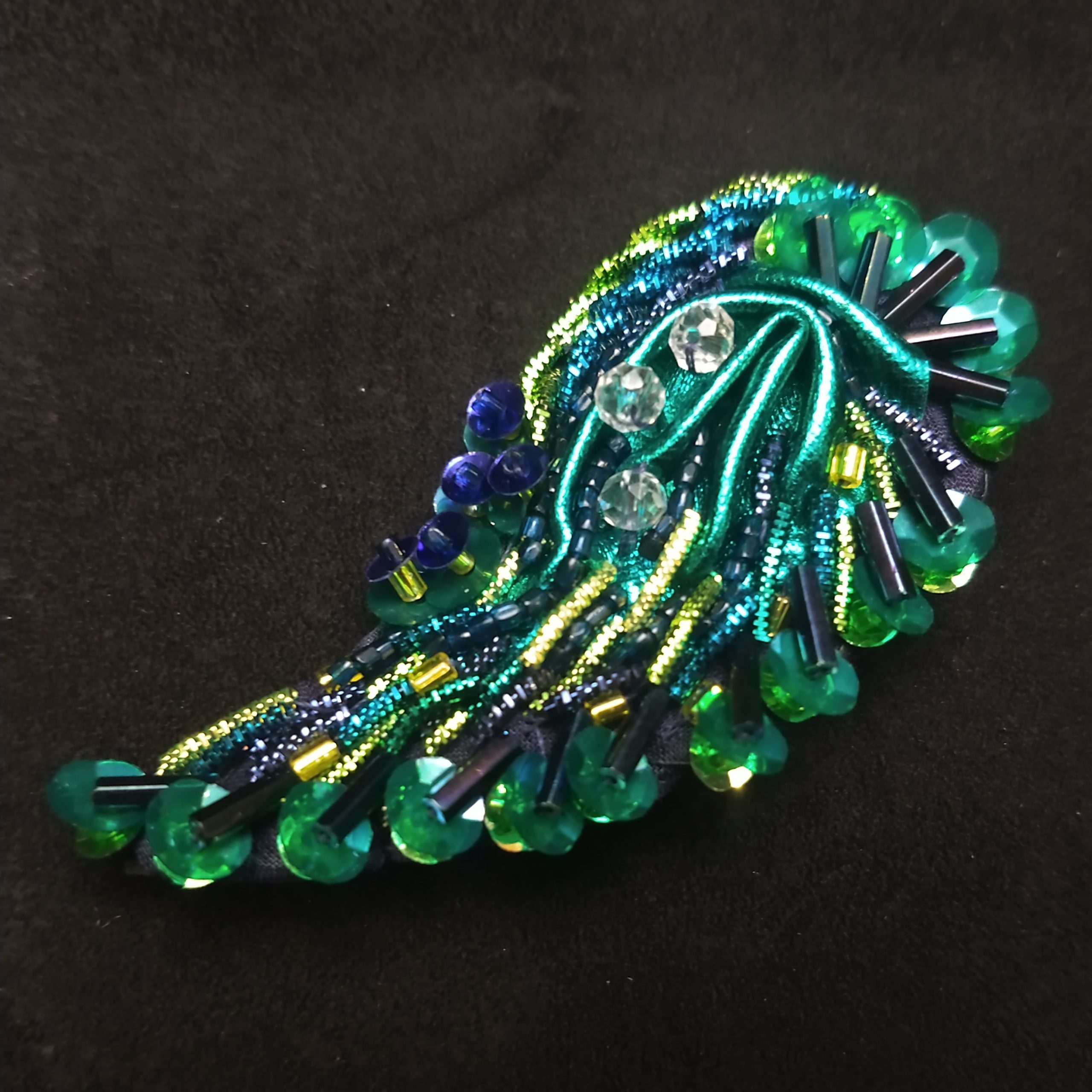
You will create a stunning piece of embroidery on silk organza stretched over a small embroidery hoop. For this, you can use more than 100 different beads, sequins, cannetilles, and other materials, just like those used in large embroidery studios. You will learn a number of techniques to achieve special effects with these beads and sequins.
Broderie d’art is the magnificent embroidery we know from haute couture; think of creations by Chanel and Dior, among others. These rich embroideries often have a 3-dimensional effect due to the combination of different materials. This type of embroidery is frequently applied as an appliqué on clothing, but it is also used to create jewelry such as brooches and earrings. Surprisingly, this technique also has a sustainable side; by creating something beautiful for your clothing, you will treat it more carefully, you might be able to hide damage with an appliqué, and it will last longer!
You will go home with an embroidery hoop containing your embroidery, a small box with examples and instructions, and extra materials to finish your piece at home.
Monique van Munster has a fascination with the endless possibilities of artisanal embroidery with needle and thread. She experiments with old embroidery techniques from haute couture to develop new forms of work. Gold embroidery has become one of her specialties, which has evolved into a style all her own. Her passion for this refined artisanal craftsmanship brought her into contact with various couturiers and designers who incorporate her broderie d’art into their collections. Her work has been featured in shows in Paris, Dubai, and recently in Palm Springs.
Her work has been included in the Inventory of Intangible Cultural Heritage of the Netherlands since 2023. Monique enjoys sharing her knowledge during lessons, masterclasses, and workshops at her studio in Tilburg, at vocational colleges throughout the Netherlands, at the Fashion Crafts Trade Association, and at other organizations where she is invited.

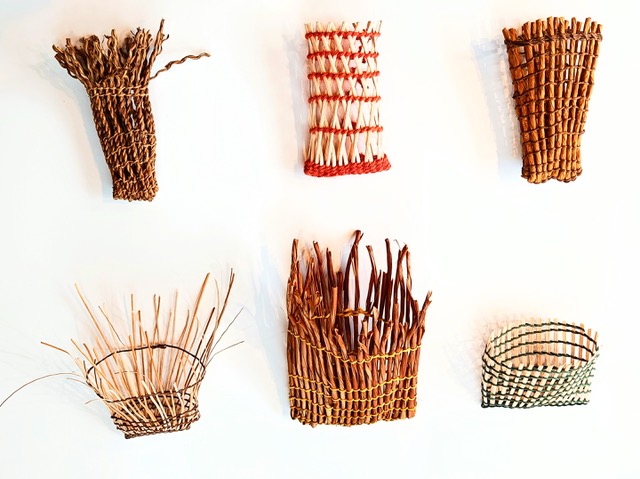
Weaving is an age-old craft in which natural, pliable materials are woven by hand into functional objects or furniture components. Although the techniques are related, they differ in application and material use.
Under guidance, you will get to work with authentic techniques and recycled materials, such as rushes, rattan, seagrass, and papercord from old chair seats. We will go through the various stages of weaving: from setting up the base (the ‘stakes’) to refining the walls.
Whether you want to make a functional basket or an abstract artwork for the wall, you will discover how material and technique come together to create a tangible result. No two woven objects are the same; you will go home with a piece that bears your own signature.
Behind LoreVlecht is the Bruges artisan Hannelore Maet. Driven by her passion for centuries-old weaving, she transformed her garage into a charming private studio in 2019, where she experiments daily with natural materials such as rattan, rushes, papercord, seagrass, and more.
Hannelore distinguishes herself through a contemporary approach to traditional techniques. She is not only a maker but also a passionate teacher with over 25 years of experience, sharing her knowledge through various workshops and courses. In her studio in Bruges, she teaches students in small groups how to craft baskets, lampshades, or even handbags themselves.
Additionally, she is known for her expertise in repairs, such as restoring chair seats. Her work bears the label Handmade in Brugge, a recognition for local makers who hold craftsmanship and authenticity in high regard. Hannelore’s driving force is the “addictive” tranquility of weaving and the endless possibilities of this craft.
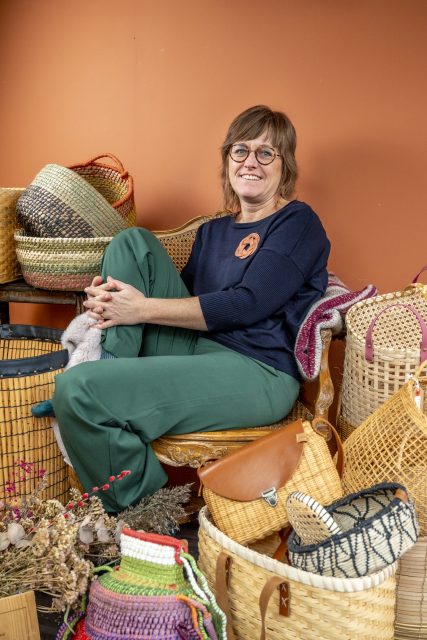
Photographer: Isabel Clyncke
This workshop is made possible by Handmade in Brugge.
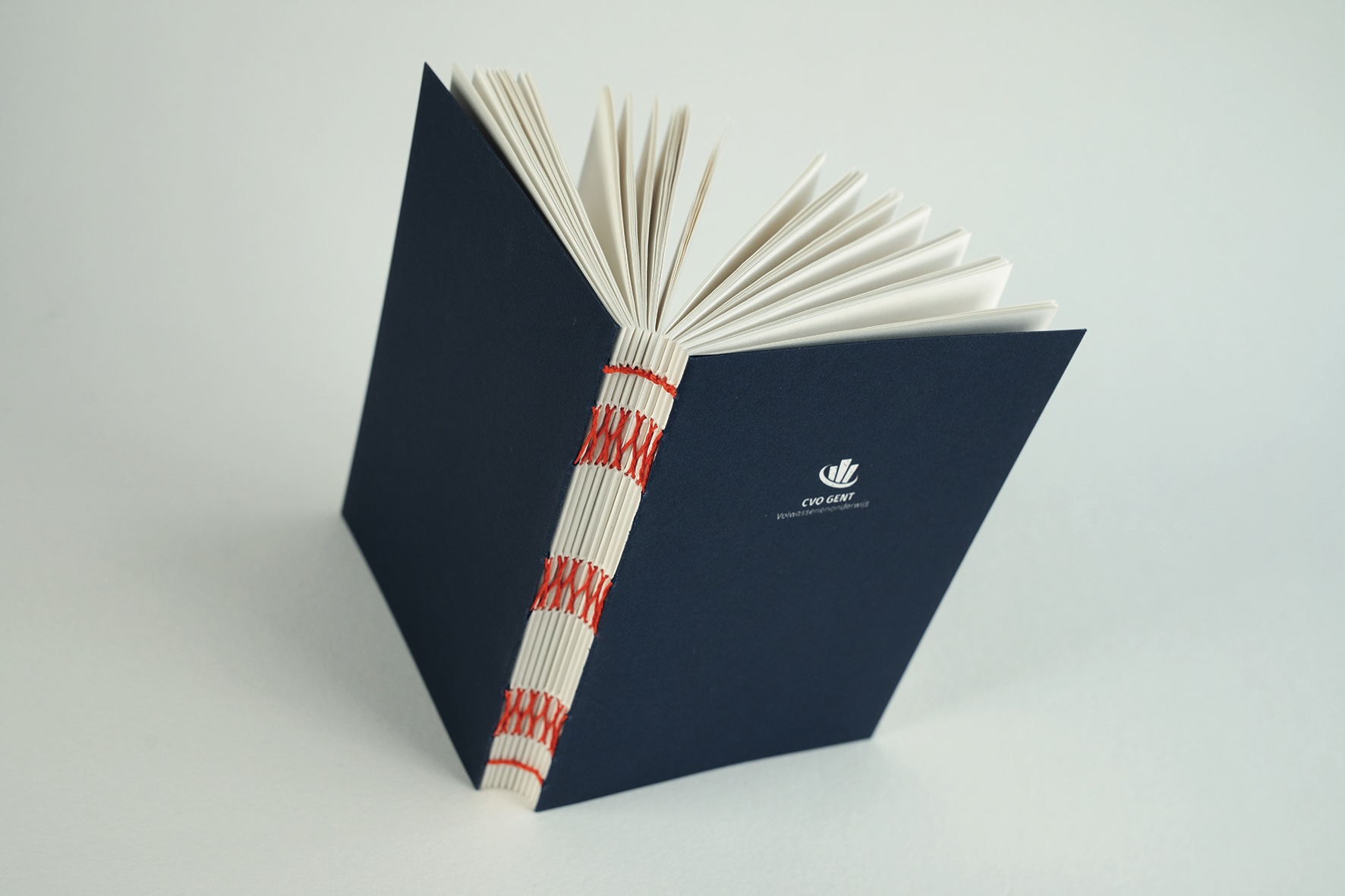
Immerse yourself in the centuries-old craft of bookbinding and experience with your own eyes and hands just how contemporary this tradition can be. During the bookbinding workshop, you will bind a personal booklet using needle and thread. Step by step, you will fold each signature, prick the sewing pattern for the French linked stitch, and then sew the booklet together by hand into a beautiful whole. The workshop is led by three experienced bookbinders who will happily guide you through the process!
This workshop is offered by CVO GENT.
CVO GENT CHERISHES ARTISANAL HERITAGE
Crafts contribute to the cultural identity and diversity of our society. They reflect the traditions, values, and history of our community. That is why we at CVO GENT consider it important to keep our cultural heritage alive and pass it on to this and future generations.
We offer 6 crafts: Handweaving, Bookbinding, Lace making, Upholstery, Ornamental metalworking, and Sewing.
BOOKBINDING
Immerse yourself and stimulate your senses throughout the entire process; prick up your ears as you rustle through your book, enjoy the scent of the paper, let your fingers glide over the cover, and feast your eyes on all that beauty.
This course at CVO GENT teaches you everything about centuries-old, traditional, and more contemporary bookbinding techniques, focusing on both general basics and refined finishing techniques. With all this acquired knowledge, you will be binding your own unique books in no time.
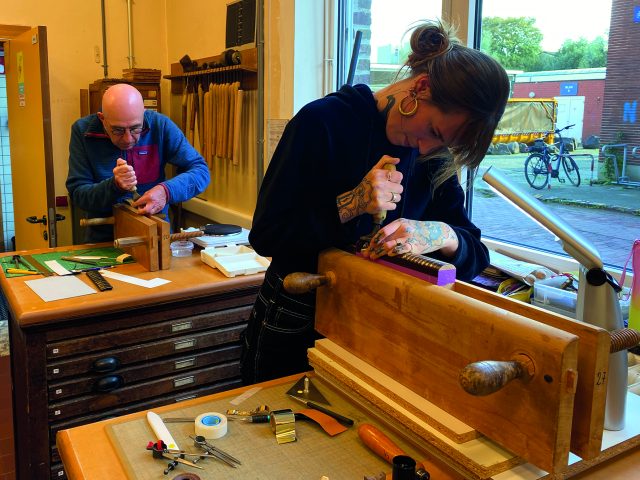

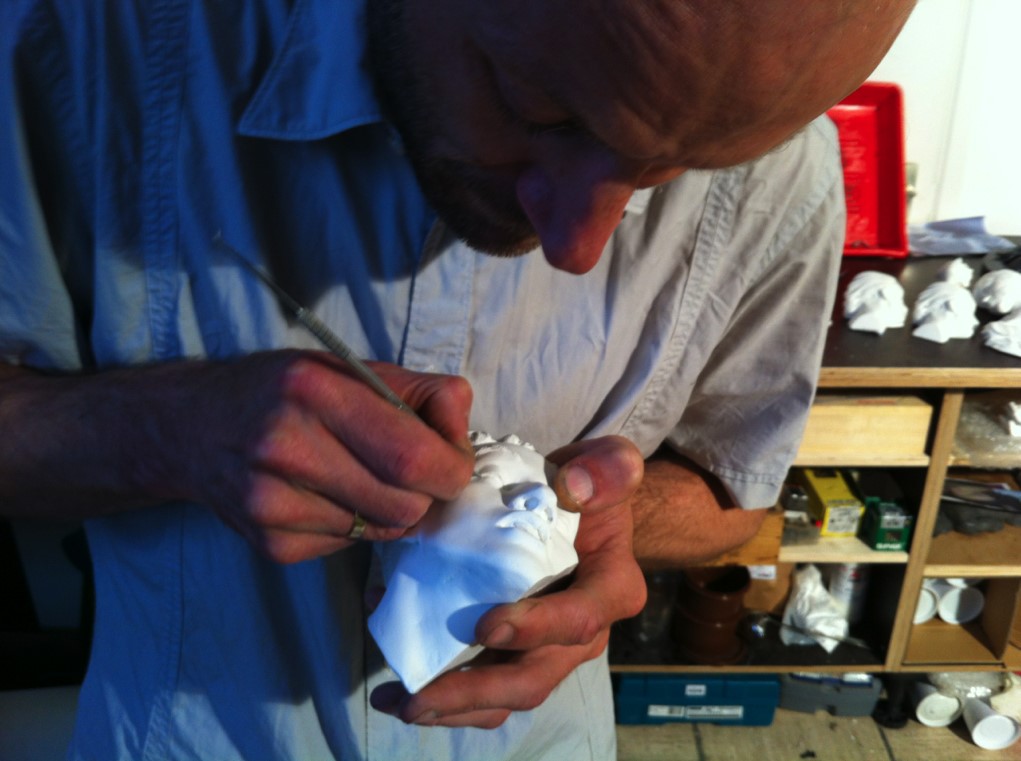
Dive into the fascinating world of sculpture and molding techniques and create your own small three-dimensional artwork from start to finish. You begin by sculpting a playful design in clay, experimenting with form, volume, and texture. Next, you learn how to build a flexible gelatin mold around your model using simple, non-toxic materials. Once the mold is ready, you cast your shape in a suitable casting material and discover the exciting moment of demolding.
You work with accessible household materials and professional basic tools, allowing you to apply the technique at home later on. In a small group, there is room for personal guidance and creativity. At the end of the workshop, you go home with a self-made casting and the knowledge to continue experimenting independently.
In the past, Bruno Hardt has been active as a visual artist in various fields: music theatre, graphic design, illustration, painting, and spatial work. Characteristic of his work throughout these different disciplines is the patience and attention to detail and nuances with which he operates. Today, he works full-time as a lecturer in Sculpture and Spatial Art in Brussels, including at the Academy of Visual and Audiovisual Arts in Anderlecht. It is based on this experience that he will guide the workshop.
This masterclass is offered by the Academy of Visual & Audiovisual Arts Anderlecht.
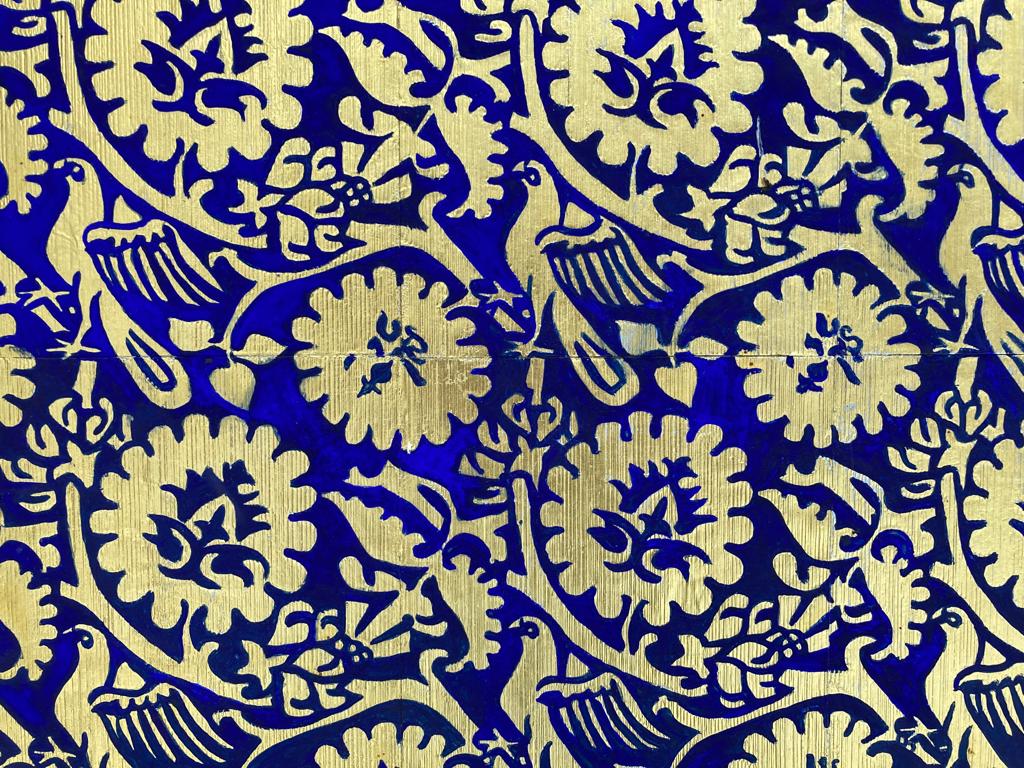
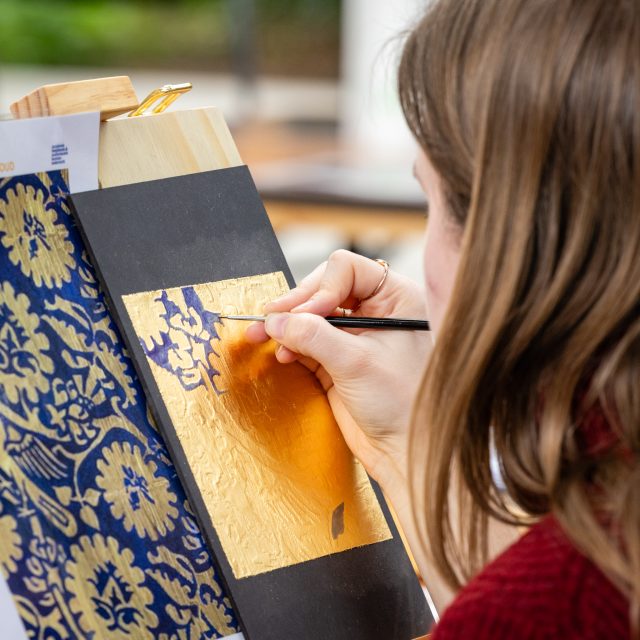
During this masterclass, you will dive into the rich world of late Gothic pressed brocade. You will create a brocade sheet yourself based on a 15th-century example and discover how luxurious silk fabrics with gold and silver threads were imitated in relief in the past.
Step by step, you will learn to work with an engraved mold and tin foil to create a refined textile relief. Next, you will gild the surface with gold leaf and finish it with transparent or opaque pigment layers in deep red, green, or blue tones. Through hatching and painting techniques, you will mimic the shimmer of woven gold threads.
You will work with authentic materials and professional tools provided. At the end of the day, you will take home a self-made sheet of pressed brocade — a tangible result of a centuries-old artisanal technique.
This masterclass is offered by the Academy of Visual & Audiovisual Arts Anderlecht. In the Art Craft Polychromy studio at the Academy of Visual & Audiovisual Arts Anderlecht (ABKA), you will discover historical painting and decoration techniques in all their richness. You will learn to work with traditional techniques such as gilding and silvering with leaf metals, and apply methods such as pastiglia, pressed brocade, sgraffito, punching, and gemstone imitations.
You will develop skills not only to technically execute these decorative finishes, but also to recognize, analyze, and reproduce them. Within the studio, you can delve into heritage conservation and restoration or choose a contemporary track in which experimentation and personal visual language take center stage. Throughout the learning process, you will build a personal portfolio in which all technical steps, material research, and artistic evolution are carefully documented.
Sandy van Wissen (1968) works in various capacities within the cultural heritage sector in Belgium. She works hands-on with the conservation, research, and restoration of polychrome sculpture at a federal non-profit institution in Brussels. In addition, she is employed part-time as a teacher of Art Crafts in Polychromy, where both historical and modern decoration techniques are taught, and serves as Pedagogical Coordinator. The program is offered as Part-Time Art Education in Anderlecht.
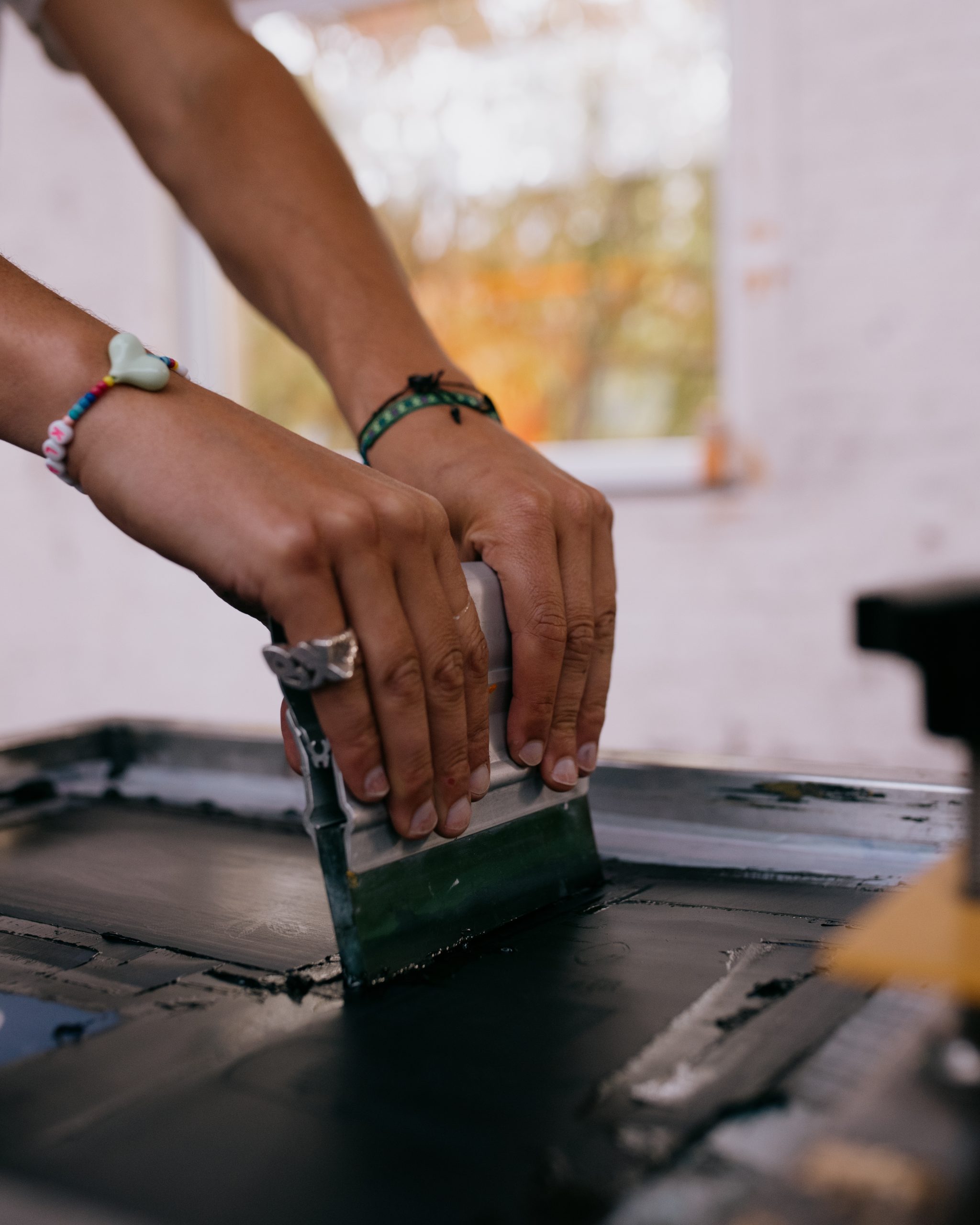
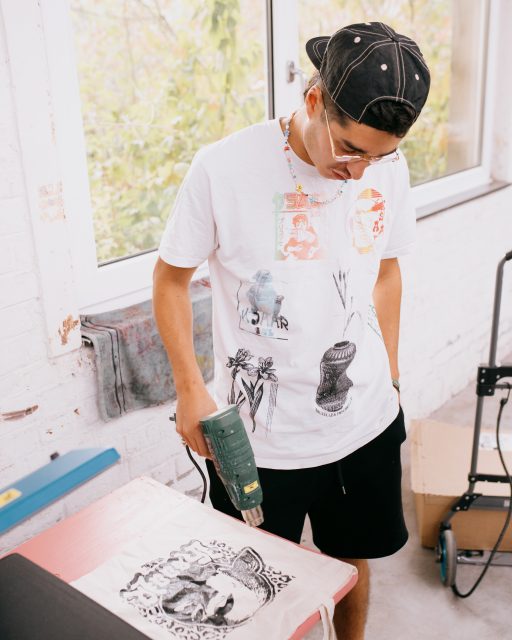
In this workshop, you will learn what screen printing is. You get to get hands-on and learn to print your own garments. You will have the creative freedom to choose from various unique designs, colors, and positioning. We will work with screen printing frames, carousels, squeegees, and ink.
Screen printing is an artisanal printing technique that can be used to print on textiles, paper, and various media. You will use a screen printing frame (a type of stencil) and a squeegee to print your chosen design and color.
Ksaar is a multidisciplinary Brussels brand with a local and DIY approach that designs clothing and accessories inspired by the city of Brussels. They regularly share their techniques, knowledge, and creations with the public through live sessions, workshops, and events.
Bring your own garment(s) for this workshop!