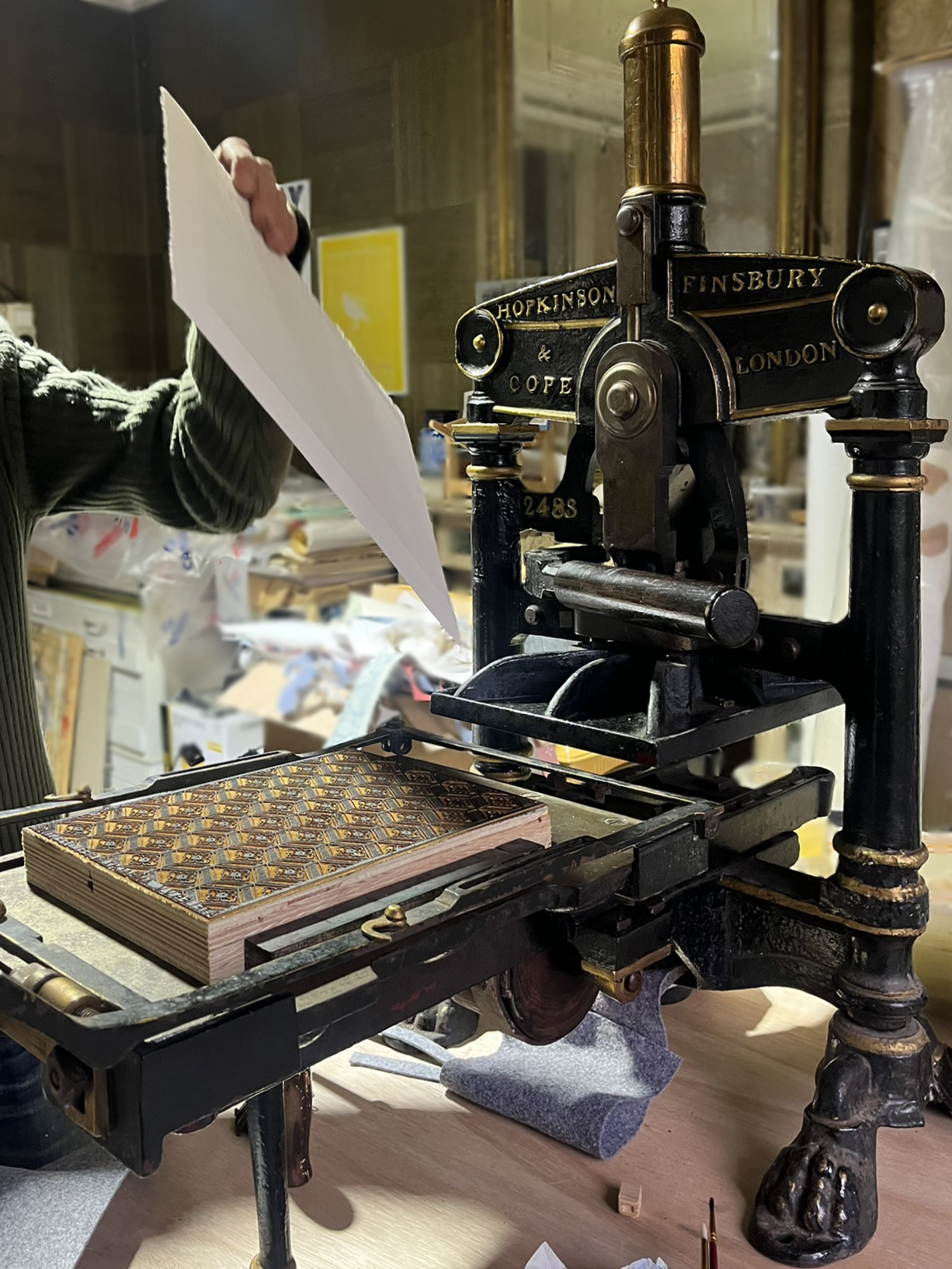
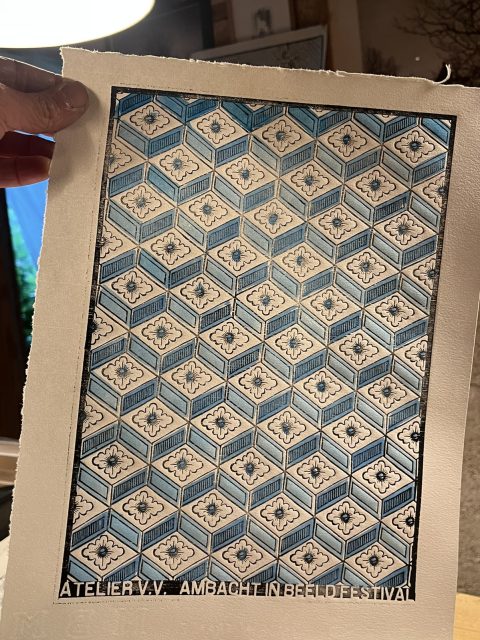
During this workshop, you will get hands-on with a classic platen press from the first half of the 19th century. You will print a domino, an early form of wallpaper, using a wooden block.
After printing, you will finish your print with color, applied using a stencil and brush. For this, you will use an ink prepared according to a historical recipe, based on gum arabic and pigment.
You will learn how printed matter was constructed in the past: applying ink, positioning the paper, setting the print, and finishing. No theory, just doing.
You will work with authentic materials: wooden printing blocks, traditional inks, and Arches paper.
Afterwards, you will take home a unique, handmade sheet.
Everything happens continuously: you can join in, participate, and move on. Short, tangible, and direct.
Atelier V.V. creates hand-printed wallpaper using a technique that had disappeared from Belgium for more than half a century: printing with the slab. Dimitri and Vicky print their patterns block by block, color by color, using large wooden printing blocks and paint they make themselves based on historical recipes.
Where industrial wallpaper is flat and uniform, here a surface emerges with nuance, depth, and small variations — visible and tangible.
In addition to rolls of wallpaper, Atelier V.V. also prints dominoes: early forms of printed paper that served as precursors to wallpaper. These are printed sheet by sheet, just as in the past.
The atelier works on both new interiors and restorations, always with respect for materials, techniques, and history.
Dimitri Vermeylen is the driving force behind Atelier V.V., which he founded together with his wife Vicky Vermeire. After a career of more than twenty years in the business world, he returned to a craft practice, with a strong focus on historical printing techniques.
He immersed himself in the subject through volunteer work at the Industrial Museum in Ghent, among other things, where he worked with typography and lithography. Today, he and Vicky combine that technical craftsmanship with their own research into historical dyeing and printing methods.
Atelier V.V. has grown into one of the few studios worldwide that prints wallpaper in this way again.
During workshops and demonstrations, Dimitri shares his knowledge in a direct manner: not academically, but by doing, with attention to materials and techniques.
Thanks to Erfgoedcel Vlaamse Ardennen (Variant), FILA Benelux for sponsoring the Arches paper, and thanks to Patrick Goossens.
Thank you to the players of the National Lottery! Thanks to them, the National Lottery is once again supporting the Ambacht in Beeld Festival Brussels this year.
THE LOTTERY IN BRUGGE IN 1441, CULTURAL HERITAGE
In the Middle Ages, an unprecedented initiative was taken in Bruges, of which they could not have imagined that it would lay the foundation for what we know worldwide, 580 years—almost 600 years later—as ‘a lottery’. At that time, Bruges was a very flourishing metropolis, but a hefty fine imposed by Philip the Good, Duke of Burgundy, and the costs associated with the frequent uprisings, meant that alternative ways had to be found to finance useful matters for the community without having to levy extra taxes. Just as today, this was not a popular measure in the Middle Ages.
The ingenious plan to organize a lottery with various prizes to collect voluntary contributions and use the proceeds to fund collective needs proved to be a resounding success. Their historic decision, nearly 600 years ago, would change the European lottery landscape forever. The idea quickly caught on. Other cities, always looking for new sources of income, followed Bruges’ example. This happened first in the immediate vicinity, in other cities in the Burgundian Netherlands: Sluis, Ypres, Ghent, Lille, Nieuwpoort, Oudenaarde, Antwerp, Leuven… Between 1441 and 1500, at least 82 lotteries were organized in the Low Countries (although the majority were still in Bruges; from the sixteenth century onwards, the center of gravity shifted to Antwerp). But lotteries also appeared in Germany from 1470, and it was the lotteries in Rome, Genoa, and Venice that, from 1504 onwards, turned the Italian word ‘lotto’—derived, just like ‘loterij’, from the Dutch word ‘lot’, meaning chance—into the internationally recognizable brand name. The lottery thus followed the path of the trade routes of the time, from the Netherlands via Germany to Northern Italy. In the sixteenth century, we see them appearing all over Europe.
The motive of the organizer, usually a city but sometimes also a private organization, was naturally to make a profit. However, this was used to finance collective needs: strengthening city walls, building a hospital or a church, or paying off debts, as in the case of that first draw in 1441. This social aspect is also still an essential characteristic of a lottery. In 2023, the National Lottery of Belgium provided 345 million euros in support to numerous projects and associations with a humanitarian, social, sporting, cultural, and scientific purpose.
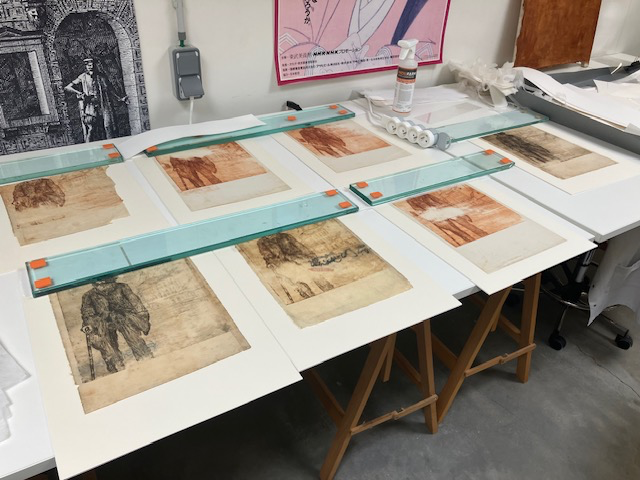
La Route du Papier was founded in 1993 by Anne Liénardy. She was an independent paper conservator and lecturer at La Cambre, but could not find suitable materials anywhere. Therefore, she decided to establish a company for this purpose herself. La Route du Papier grew into the reference in Belgium regarding the distribution of materials for the conservation and restoration of artworks and documents on paper. In 2023, the company was acquired by Alexander Vander Stichele.
La Route du Papier represents products from various foreign firms specializing in the conservation and restoration of artworks and documents on paper.
The catalog includes hundreds of items: Japanese paper, acid-free Western paper, cardboard for museums and conservation, storage boxes, polyester films and sleeves, materials for archiving photographic documents, adhesive tapes, and restoration materials. A selection of these will be for sale during Ambacht in Beeld.
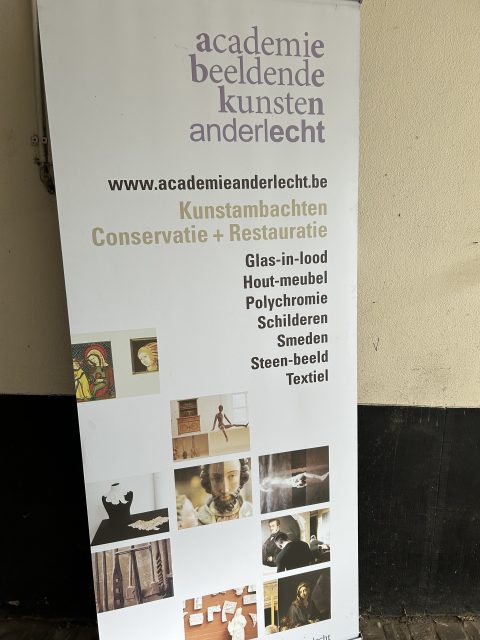
At the booth, we introduce our art school and all its departments through a presentation of objects, flyers, moving images on screens, and verbal explanations. In addition to the four workshops, we provide more information about our school here.
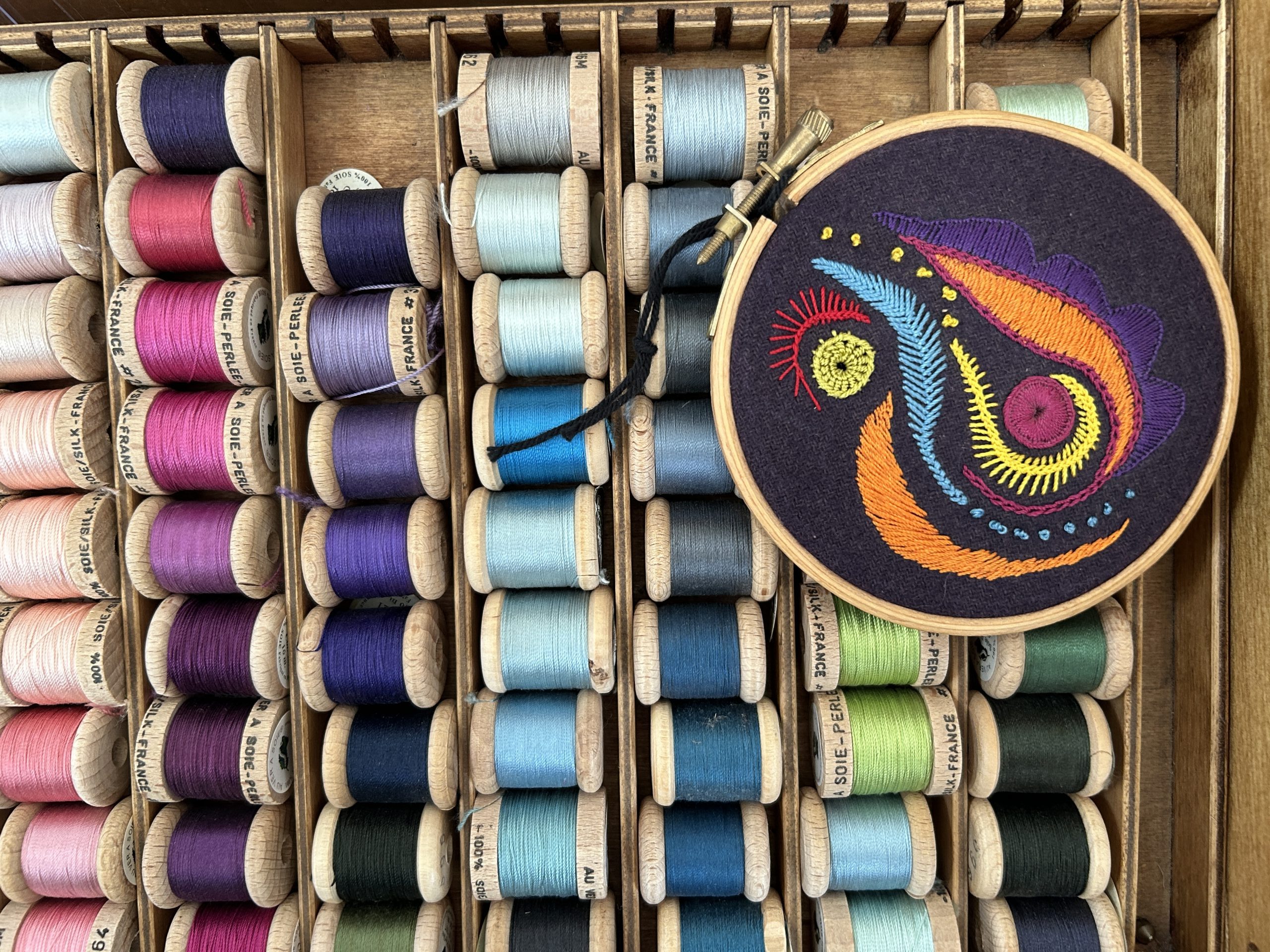
Moniquenwerk Broderie d’art is the shop for materials for broderie d’art and gold embroidery, run by Monique van Munster.
Broderie d’art is the artistic embroidery used in haute couture in Paris. Monique regularly travels to Paris to source the most beautiful beads and sequins. The shop also specializes in silk embroidery threads and other fine threads.
Monique has been involved in needlework her entire life. Since 2013, she has had an embroidery studio in Tilburg. In her studio, Monique teaches broderie d’art, gold embroidery, and 3D embroidery. Her students come from all over the Netherlands, and even from Germany and Belgium to attend her classes. Since 2023, Monique van Munster’s broderie d’art has been included in the Inventory of Intangible Cultural Heritage in the Netherlands.
Because she often works with hard-to-find materials, she began sourcing them for her students. The product range grew out of the lessons but has since expanded into a treasure trove for embroiderers who love experimenting with unique materials.
At Ambacht in Beeld (Craft in Focus), Monique sells materials for gold embroidery such as gold thread and cannetilles, silk embroidery threads, beads and sequins, coloured silk organza, several types of ribbons and trims, silk velvet, and materials to make handmade buttons.
During the festival, Monique also teaches masterclasses Beautiful embroidery.

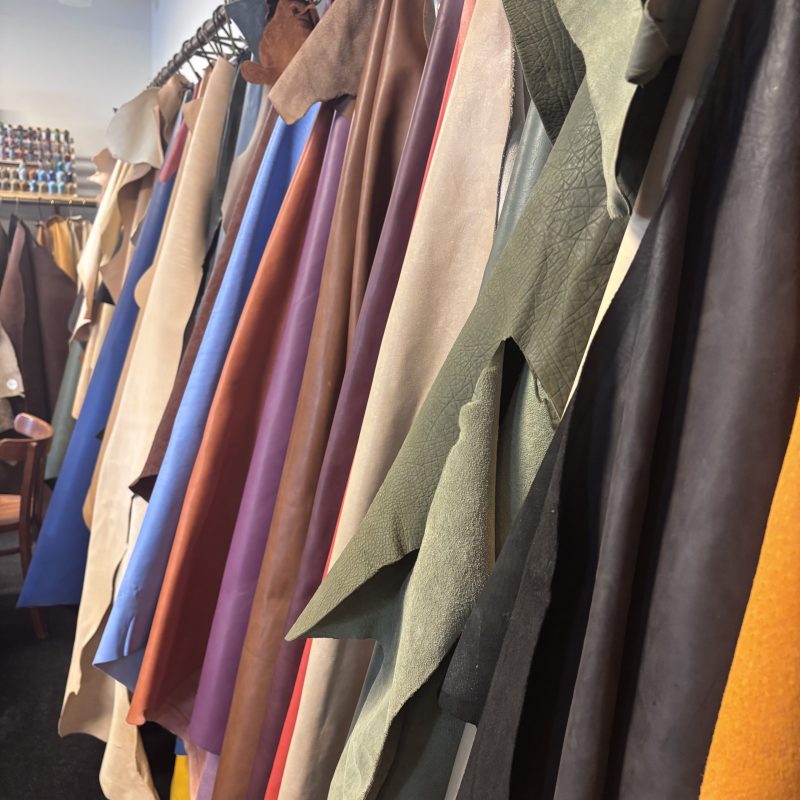
In the 19th century, leather hides were often discarded as a byproduct due to cultural norms and hygienic concerns. The ancestors of HAB-TO Leather House‘s founders recognized the importance of not wasting these natural resources in the mid-19th century. They began collecting, salting, preserving, and tanning hides, building a large network in Western and Eastern Europe.
While HAB-TO Leather House requires sustainability certifications from suppliers, they believe that true sustainability goes beyond a piece of paper. It revolves around a deep understanding of the entire supply chain. Their core value and cornerstone is the exclusive use of vegetable-tanned leather.
During the festival, HAB-TO Leather House will give presentations about their unique OLIVE LEATHER product, and they sell supplies and tools for leather workers and hobbyists.

During the festival, children can make their own mosaics using all kinds of odds and ends. They can use any kind of material—those bits and pieces, toys, and trinkets that everyone has lying around.
Materials will be available for the children to choose from to form their own mosaic. The children can then decide for themselves whether to fill in a drawn silhouette or to sort out the colors to create a more realistic image.
The panels will eventually form one colorful whole.
Ismaël Bils studied installation art at KASK in Ghent and creates all kinds of artworks, primarily using recycled materials. Years ago, Ismaël started making mosaics from all kinds of waste materials. He began with simple silhouettes, filled with all kinds of colorful material. First on boards and on the wall of his room. But because he enjoyed it so much, he eventually decorated the entire garden wall of his house.
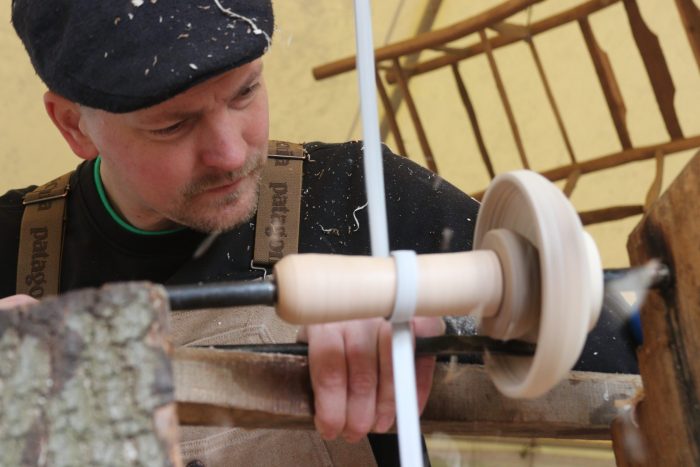
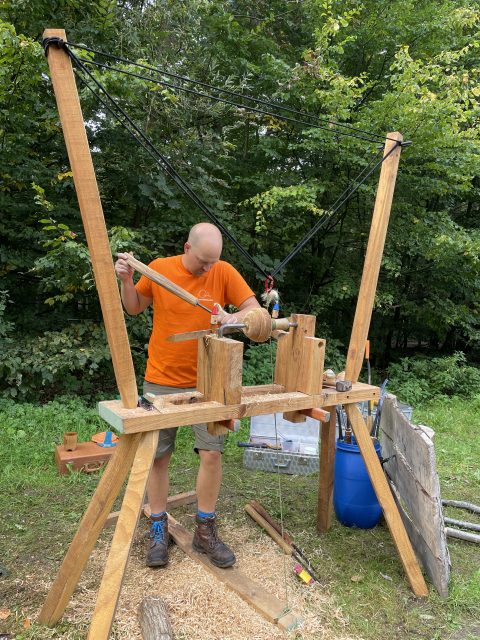
The rocking lathe is the predecessor of the electric lathe. This foot- and muscle-powered lathe is used to turn bowls, cups, plates, jars, boxes, and other utensils from wood.
The craftsman starts with a rough piece of fresh wood and uses an axe to achieve a rough shape; subsequently, he uses self-forged turning jigs and the rocking lathe to give the object its final form.
Pieterjan’s adventure with the rocking lathe began out of curiosity about traditional greenwood working techniques. This journey of discovery started years ago with spoon and other carving, transitioned into making stools and chairs, and eventually led to turning on a rocking lathe. A world of turned objects, such as bowls, boxes, cups, and jars, opened up for him.
It soon became a passion that led him to embark on a Master-Apprentice program together with Martijn Van Gerwen. Through this scholarship, he and Martijn apprenticed with experienced craftsmen in England. This strengthened his growth as a green woodworker, and he is breathing new life into this ancient craft. By now organizing workshops himself, he encourages others to discover this beautiful craft and experience what it is like to work with green wood and create unique, usable objects.
During the festival, he will give free continuous demonstrations.
This program is made possible by Dijk92.
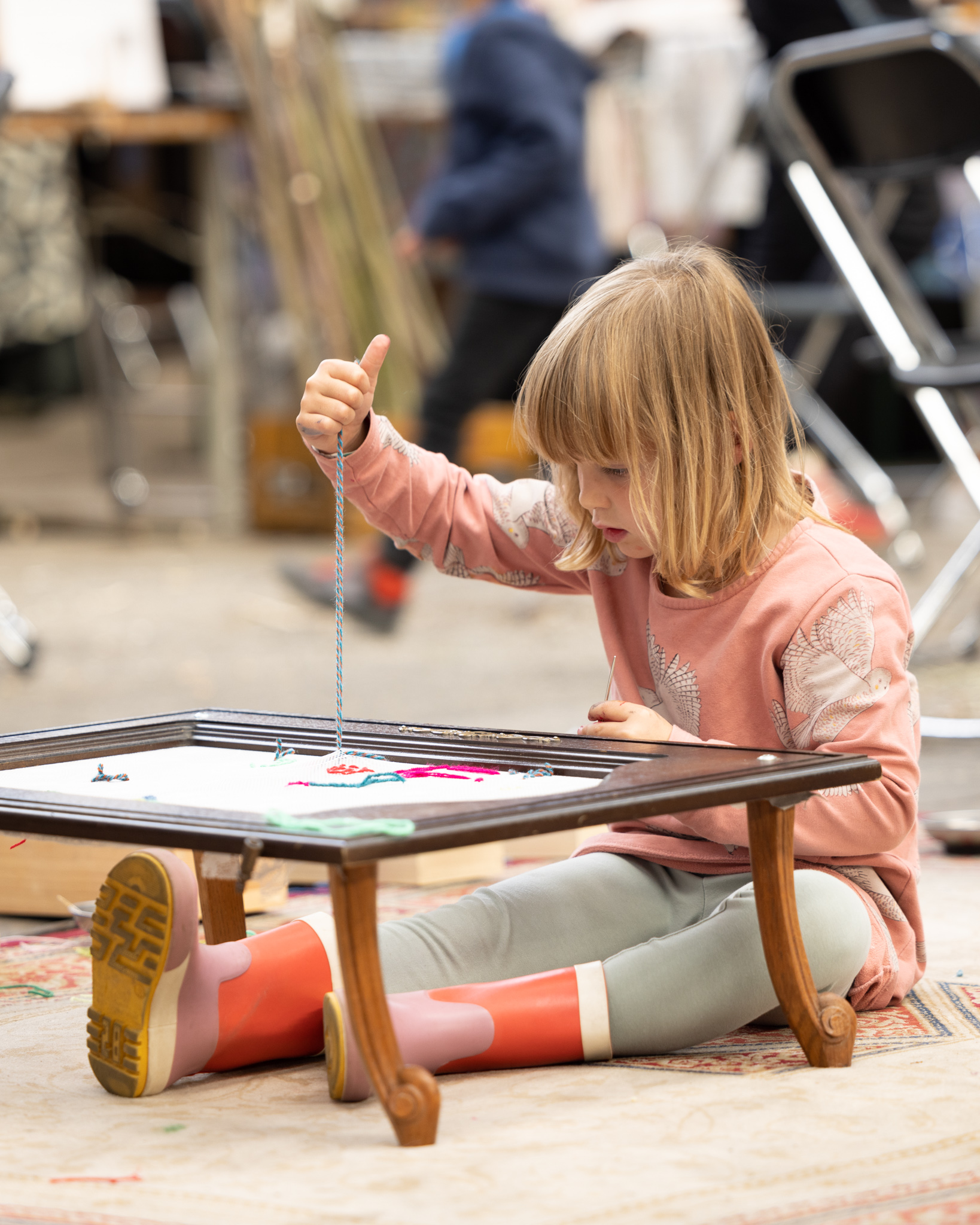
Take a seat (together with your child) at an embroidery table and embroider without compromise, without prescribed rules or patterns.
Our tables were specially designed for small children to embroider on in a simple way. We find the ‘doing’ and the pleasure in doing it more important than the result.
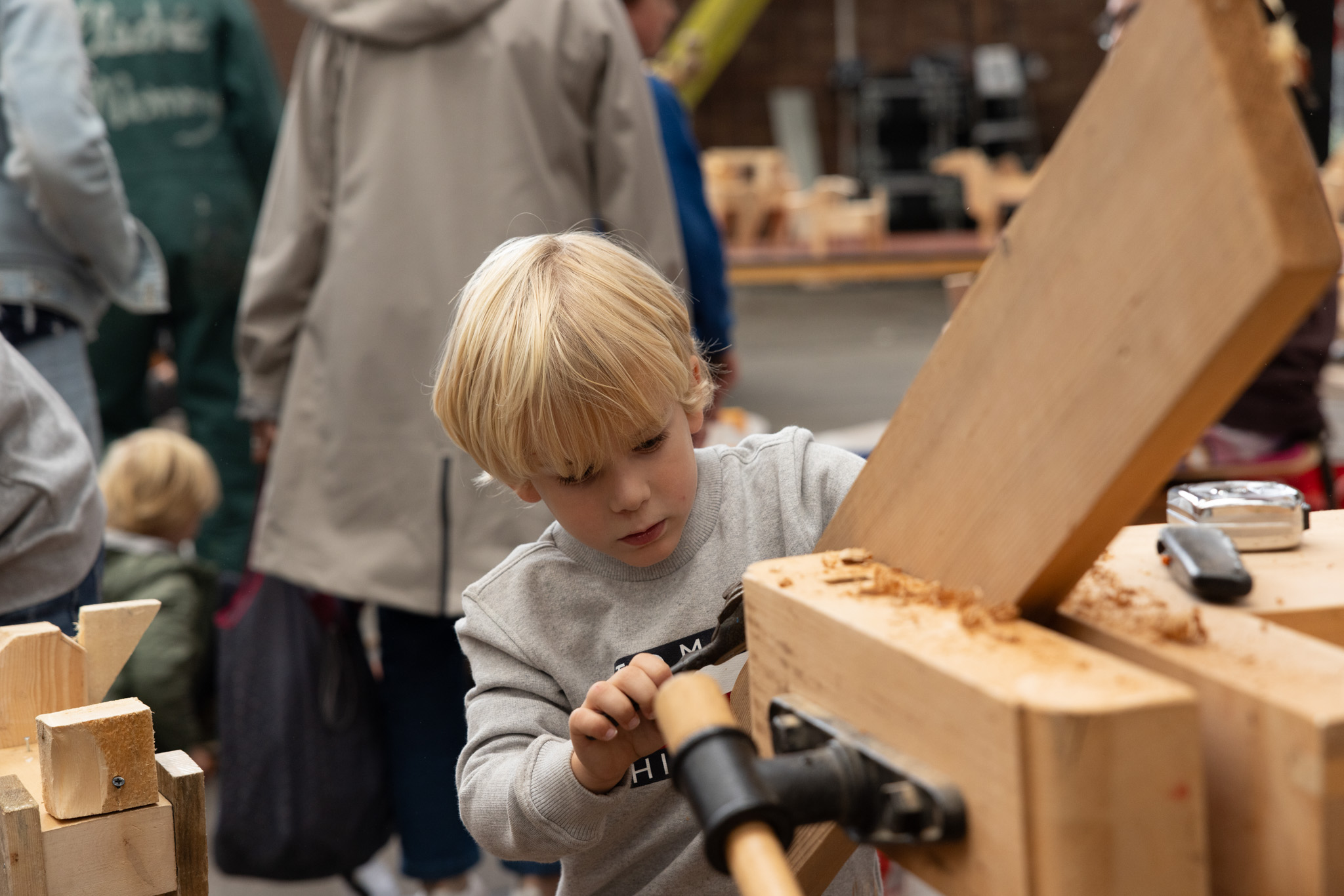
We are organizing an open workshop where children and their parents/guardians build a joint project using wood.
Together, we bridge a fictional river. We build a real bridge from where we are now to where we want to go.
The bridge connects us with our fellow builders, but also with the place we want to be (get to).
Please note: parents/guardians are responsible for their children at all times and must remain present during the workshop.