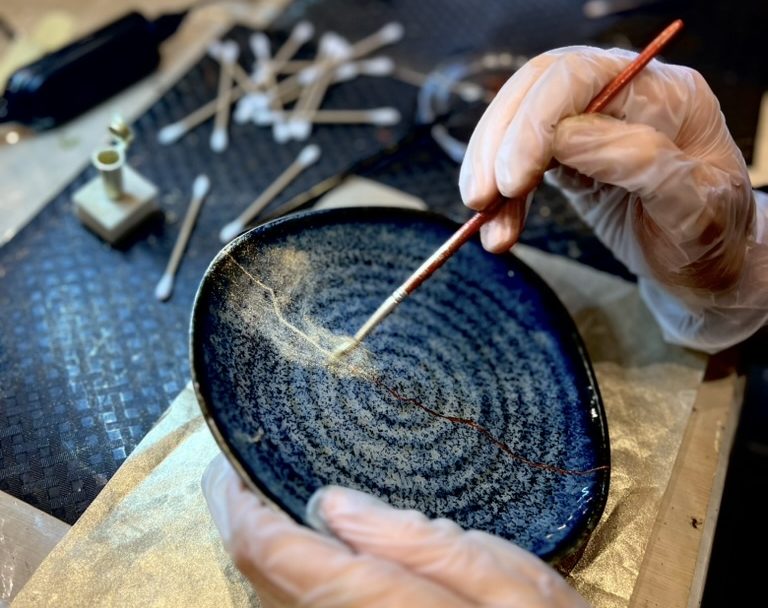
Kintsugi is a traditional Japanese restoration technique that breathes new life into broken ceramics. By using Urushi, the natural sap of the Urushi tree, and decorating the repaired cracks with gold, silver, or vermilion, each piece becomes a beautiful work of art.
Kintsugi is more than a craft – it is a philosophy rooted in acceptance and resilience. By highlighting the scars rather than hiding them, this centuries-old method teaches us to embrace flaws and imperfections.
In this workshop, you will be introduced to traditional Japanese restoration techniques, the history of Kintsugi, and the key material: Urushi, a Japanese lacquer. Learn how to repair broken bowls and decorate them with gold, while rediscovering the beauty of imperfection.
Each participant receives a Kintsugi bowl, and during the three-hour workshop, you will follow the process step by step: gluing, cleaning, filling, painting, and finally sprinkling with gold powder to complete your unique creation. At the end of the workshop, participants take their own Kintsugi pottery home in a specially designed box in which the paint can dry.
Yuki Tessler teaches Kintsugi workshops and courses in the Netherlands, France, Denmark, and Belgium. Originally from Saitama, Japan, her journey began as a lighting designer in Tokyo, where she worked for ten years. Her deep fascination with traditional Japanese art and culture has always shaped her work. Theater technology gave her practical insights into Japanese craftsmanship and its long tradition. During a philosophy degree, specializing in Buddhism, she explored the concepts of wabi-sabi and Zen that underpin the Japanese cultural mentality. The Kintsugi and Urushi art, which are part of this, enable her to embrace imperfection. Sharing the Kintsugi philosophy through workshops has become a way to foster cultural exchange and celebrate Japanese artistry.