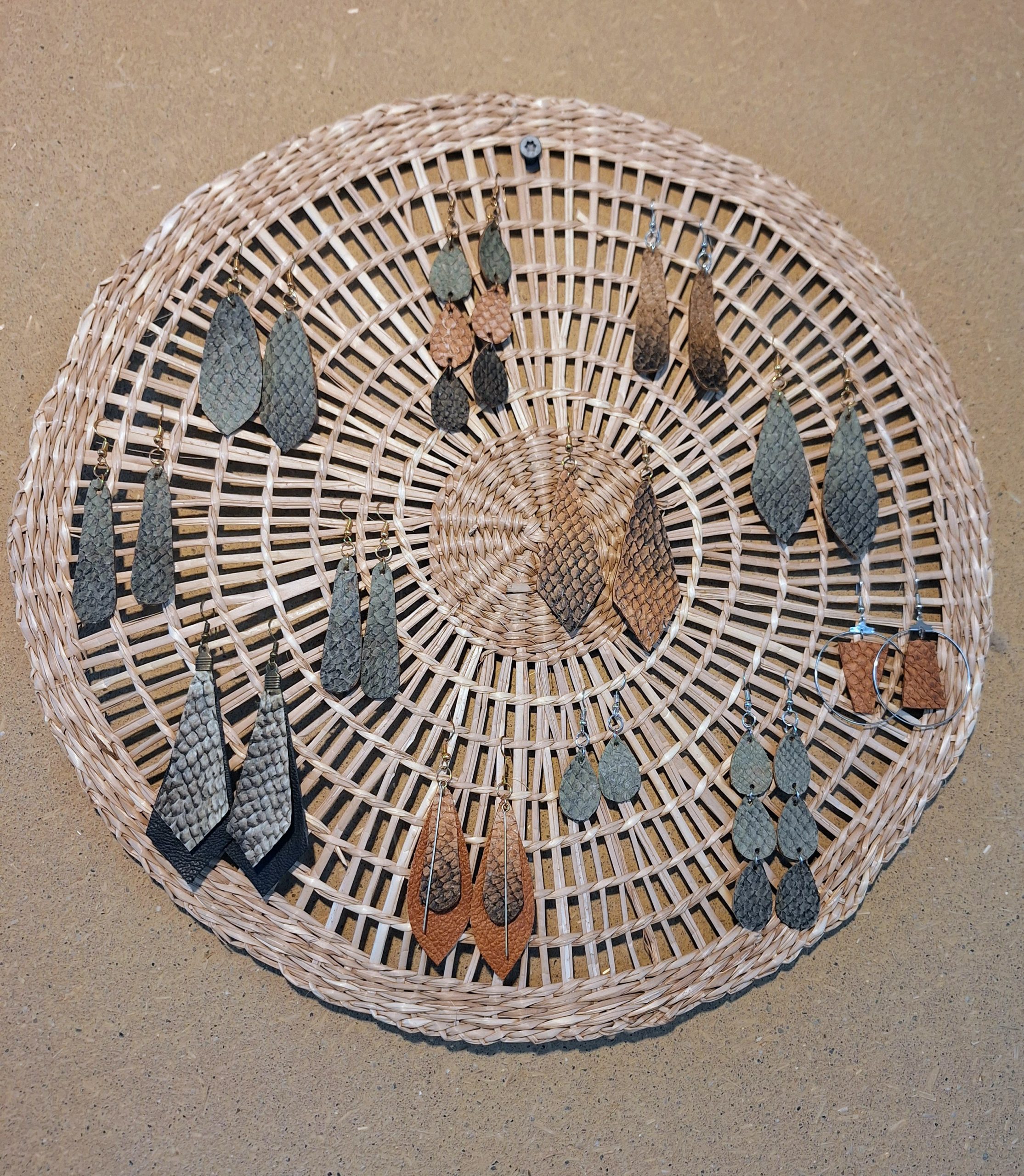
During this workshop, you will let your creativity run wild and get to work with naturally tanned salmon leather. You choose what you want to make yourself: a pair of earrings, a pendant, or a keychain.
Tanning fish skins into leather is an age-old craft, yet for many, it remains an unknown technique. Although fish leather is relatively thin, it is surprisingly strong and a feast for the eyes. For generations, it has been used to make clothing, shoes, pouches, jewelry, and much more.
With the growing focus on recycling and sustainability, fish leather is regaining popularity. You transform what would otherwise be waste from the fishing industry into a unique and sustainable product with character.
Lynn Vanheste is a secondary school teacher by training and currently works as an MOS supervisor. In this role, she supports schools in developing an environmentally friendly and sustainable learning and living environment. In her spare time, she is a co-director and active member of Bushcraft West vzw, where she organizes and leads numerous workshops. Her great passion lies in processing natural fibers, and in particular in hides, both animal and plant. Thanks to a grant from the Flemish government, she was able to further deepen her knowledge and skills in the traditional and natural tanning of hides together with Beke Olbers of EXTRA Bushcraft. Today, she gives various workshops and training courses in which she passes on the craft of making sustainable and ecologically responsible leather from slaughter waste. You can find more information about the program here.
Traditional and natural tanning is a method of transforming a raw animal hide, sourced from slaughter or hunting, into a durable leather hide. This process uses only natural raw materials, often collected in the immediate vicinity. No chemical or other artificial products are involved. The end product is fully biodegradable. The entire process is carried out with the utmost respect for nature, which stands in stark contrast to the environmentally unfriendly and often inhumane conditions of contemporary leather production.
Thanks to these traditional tanning techniques, we can produce ethically and ecologically responsible leather that lasts for generations. It forms a valuable and sustainable alternative to industrially manufactured leather, which is often treated with heavy metals and other harmful substances.
This workshop is offered by Erfgoedcel Midwest.